Although Steam Has Contributed to Gaming on Linux, We Still Need to Be Wary of the Threat It Brings as Non-Free Software.
Why do users who pursue free software still play closed-source game programs? And help this kind of ecosystem do evil?
Honestly, I can no longer look at any game console casually. Game consoles are also a kind of computer, and they need software. After I learned that consoles such as Playstation and Switch all run on heavily modified BSD systems, and that they are non-free systems, I could no longer accept playing games on them. Game discs are often locked to specific platforms and are hard to circulate. Therefore this is not freedom. I more strongly support playing games on PCs. And when it comes to stores that sell games, the biggest one is Steam, which can also count as a console platform. Besides selling games, it is also a game launcher.
Although Steam has contributed to gaming on Linux, simplifying the pain of playing games through Proton and Steam Deck, it is in reality promoting a closed platform. This is no less than Google Chrome’s ambition to occupy the browser market. After all, it is still proprietary software, and it is driven by a commercial company. Cross-platform support is about expanding commercial reach and covering as many places as possible, not about putting concern for users first, right?
Playing games can easily corrupt the heart. According to the psychological temptation techniques set up by developers, it makes you fall into the traps commercial companies use to seduce you. I know! Not all games are like this, but for games to be fun, they need these mechanisms to tempt people. Psychology is very important in games! Otherwise you would not get addicted to having characters in games call you husband/wife in a daddy-flavored voice!
If Steam has not reached the level of openness of Flathub, then it is still an object we need to be wary of. Valve not doing evil at the current stage does not mean it will not do evil later. We can only hope Gaben lives a long life.
The deeper problem is: why can users who prefer free and open source software make an exception for games? Are games not also a kind of software? I think the discussion here is pretty good: Why are people here so worried about proprietary programs, but games get a pass?
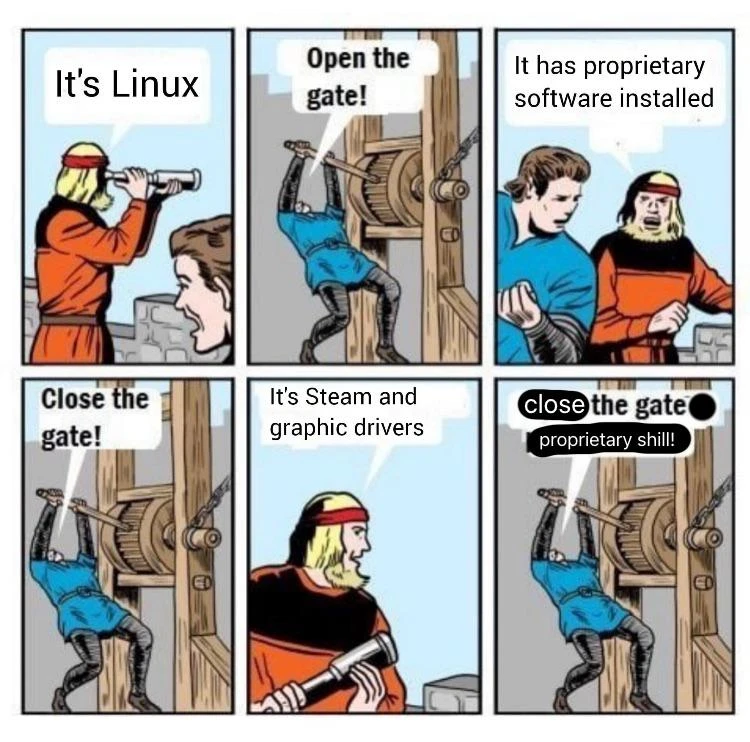
There is also a meme describing this hypocritical mentality. Image source
Here I want to digress a little. Some free software developers have pretty sharp mouths. For example, early versions of Sway did not support Nvidia, partly because Nvidia’s Wayland support was very poor and required workarounds. Therefore, when launching Sway on an Nvidia graphics card, you had to add the --my-next-gpu-wont-be-nvidia FLAG. After Nvidia support improved, this FLAG was changed to --unsupported-gpu.
Also, the author who ported Steam to FreeBSD: shkhln/linuxulator-steam-utils, believes Steam has full read access to the home directory, and malicious programs could steal your SSH keys. Therefore, you should create a user account specifically for running Steam. Otherwise you have to add the “I am an idiot” environment variable: DUMB_PERSON_FLAG = '--allow-stealing-my-passwords,-browser-history-and-ssh-keys' before Steam can start.
Eh? Why does the Linux community not have this kind of concern? Whether Ubuntu or Arch Linux users, everyone just installs Steam without a second thought.
Open source believers are generally allergic to proprietary software. They think Microsoft and Adobe are villains, and our open source software is better, but only make an exception for those selling games. They think Gaben is a chad who will not do evil like other tech giants. Therefore, when it comes to anti-cheat systems and DRM mechanisms on Steam that violate user rights, they choose silent acceptance rather than resistance.
Do not forget that Steam also monitors your playtime 24 hours a day. It feels scary just thinking about it. Why is Google not allowed to monitor you, but Steam is?
Even if Steam itself does not say games must use DRM or any anti-cheat mechanism, using this platform makes you a tacit accomplice to these mechanisms!
Think about how many magical operations vendors now perform for anti-cheat, while constantly saying it is for your security. Just look at Windows game vendors implementing kernel-level anti-cheat programs to prevent cheating, and you will feel your hair stand on end. These pieces of software are viruses themselves. They are as evil as DRM anti-crack encryption. I hear Valorant’s Vanguard is the most perverted anti-cheat program. It even blocks virtual machines. No matter how I hide with QEMU/KVM, it is useless, and the computer must have Secure Boot enabled before you can play!
We are very worried that if SteamOS, in order to satisfy game developers’ anti-cheat requirements, brings that kind of kernel-level anti-cheat to Linux, it will have to scan permissions for all user programs, and may even require the Linux kernel and kernel modules to be digitally signed by specific vendors before they can boot, destroying user freedom. Then SteamOS will become another Android blessed by Play Integrity!
Taking a step back, sometimes we have to use proprietary software. Fine, games are entertainment items, the ninth art, and can barely be tolerated. If we regard games as files like videos and music, we would not refuse to watch just because the files use non-free formats like H.265 and WAV, right?
But perhaps we Linux users should treat Steam purely as a platform that sells games, and not depend too much on Steam to play games? Treat the Steam client as a browser. After downloading games into the library, close Steam and do not keep it open all the time. Since Steam game files exist on the local disk, games should be launched with an independent Wine launcher. If a game cannot be launched with Wine and must bind itself to the Steam client for DRM verification or other mechanisms, refuse to buy it entirely. That is how it should be, right?
Well…after all, the other Wine launcher solutions besides Steam are all pretty bad. Lutris, Heroic, and Bottles each have their own problems and are not as attractive as Steam. People easily give up freedom and privacy for convenience and comfort.