Debian vs Fedora, which one is more stable?
The answer is Debian with stable updates; Fedora with rolling updates is a toy. Comparing the two, the answer is obvious.
I want a multifunctional and beautiful desktop as my daily system, so I have always been a KDE Plasma fan, staying away from the anti-human GNOME and refusing to use the outdated XFCE. Let me say something intense: GNOME is not the people’s father, so why does it have to be chosen every time!
People keep trying to recommend rolling-release distributions to me, だが断る!
In a previous article, Can a Linux Desktop Distribution Really Be Both Latest and Stable? Starting From Migrating From KDE Neon to Debian, I said that after these years of difficult exploration, I believe blindly chasing the latest KDE desktop plus the rolling-update Linux distribution model is a total disaster. After using Arch Linux, openSUSE Tumbleweed, Fedora (including Kinoite), and KDE Neon, I did not have a good experience.
Something breaks every month. The desktop breaks, drivers collapse, typing stutters, games freeze, horses jump. This is not something that can be solved simply by backing up and rolling back.
So I went to use Debian Stable + KDE. It does not matter that this KDE version lags upstream by one or two years, as long as Wayland is at least usable. My hardware is not very new, and I do not need to keep updating the latest GPU drivers just to improve performance by 1%. I am also not so idle that I play with the system all day; there is no need to chase the latest KDE features every month. In addition, there is no Snap to make trouble. I have used it for about half a year now, and I feel peaceful.
My life is already chaotic enough. I do not want the only operating system I can control to also be in an unstable state, requiring constant vigilance over what has broken. I want to be a user, not a tester.
Why Is Debian’s Development Model Stable? #
Given the bad experience Fedora brought me, it is hard for me to recommend Debian Testing. I naturally dislike developers treating users as lab rats. Even adding immutable/atomic mechanisms cannot solve this problem. Upstream features change all day long, and I do not have time to accompany them in this tinkering. They seem very eager to imitate Windows and build a competitive, future-oriented system, so they adopt the rapid iteration update method of commercial software rather than taking user stability into consideration.
Refer to the lengthy Debian package lifecycle in the Debian Handbook, and you will know why Debian is so stable. On my main computer, I would rather use Debian KDE than Fedora KDE.
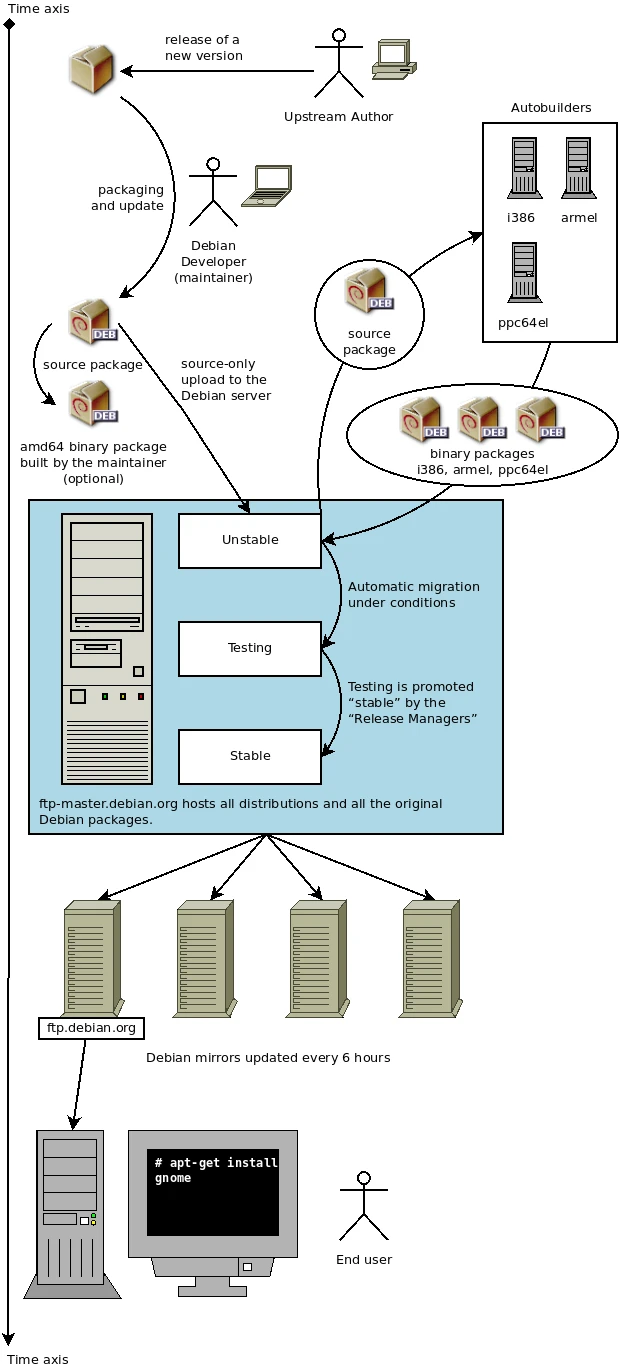
A development process that easily causes misunderstanding: Debian Sid -> Debian Testing -> Debian Stable. This development process easily makes people think all three are developed separately for a period of time before being passed down, right? No. Debian Sid is updated almost every day, with no version-number distinction.
Then, packages in Sid wait for more than 10 days, have no critical bugs, and do not break dependencies. Packages that meet the conditions automatically enter Testing. Debian Testing installation ISOs are generated from automatic snapshots. Then Testing is developed slowly. When the next release cycle approaching Stable arrives, it enters a six-month freeze period, no longer accepting new packages, allowing developers to finish fixing the remaining bugs. Only then is it finally released as Stable, with the version number updated. For example, Stable updates from Debian 12 to Debian 13, and Testing temporarily becomes Debian 14.
Between each major Debian Stable version, package versions almost do not change. For example, the GNOME and KDE Plasma desktops are basically the versions released at the time of that Debian Stable release, and they will not suddenly upgrade.
Some people think Debian Stable is only suitable for servers, while Debian Testing is more suitable for desktop users because package versions are relatively new and stable? This is obviously wrong. Unless the hardware is extremely new (released less than a year ago), Stable is the better choice.
Some Debian contributors think Testing is relatively stable, and there are even more extreme people who think Debian Sid can be used daily. You might as well use Arch Linux then!
Debian Testing cannot guarantee software has no bugs. Although it is a bit more stable than packages in Sid, this waiting process of staying still before updating is still not long enough. Since Testing is automatically merged from Sid, this means its package versions keep changing within a major version, rather than changing only when the next major Stable version updates two years later. This leaves software behavior unpredictable.
In addition, Debian Testing is called Testing because it is used for testing. Its update support cycle is not guaranteed, unlike Debian Stable, which has five years of update support.
Also, during the six-month empty window while waiting for the software to stabilize, users are placed in an awkward position. Not only are there no updates, but if major security updates appear, they must wait until Sid finishes checking before receiving them.
By comparison, if Debian Stable has an urgent bug or security issue, it can receive fixes faster.
If we make an analogy, Debian Testing is very close to Fedora’s development model, or perhaps CentOS Stream, except its updates are even less guaranteed.
Given this, after my bad experience with Fedora, I cannot recommend Debian Testing either.
How Is Fedora’s Development Model Unstable? #
Usually, Fedora is regarded as a semi-rolling distribution. It adopts a fixed update model, releases one major version every year, and system package versions are very close to upstream. Fedora’s system packages are not as old as Debian Stable’s, nor does it blindly use the latest versions like Arch Linux.
So Fedora finds a balance between instability and stable updates, suitable for users who want to try the latest Linux features but do not want overly aggressive updates.
But is this system really stable enough?
Refer to the Fedora Updates policy. Fedora has an upstream Rawhide branch. Packages are tested by developers, voted on, and after meeting standards and being considered stable, they are placed into Beta and then Stable.
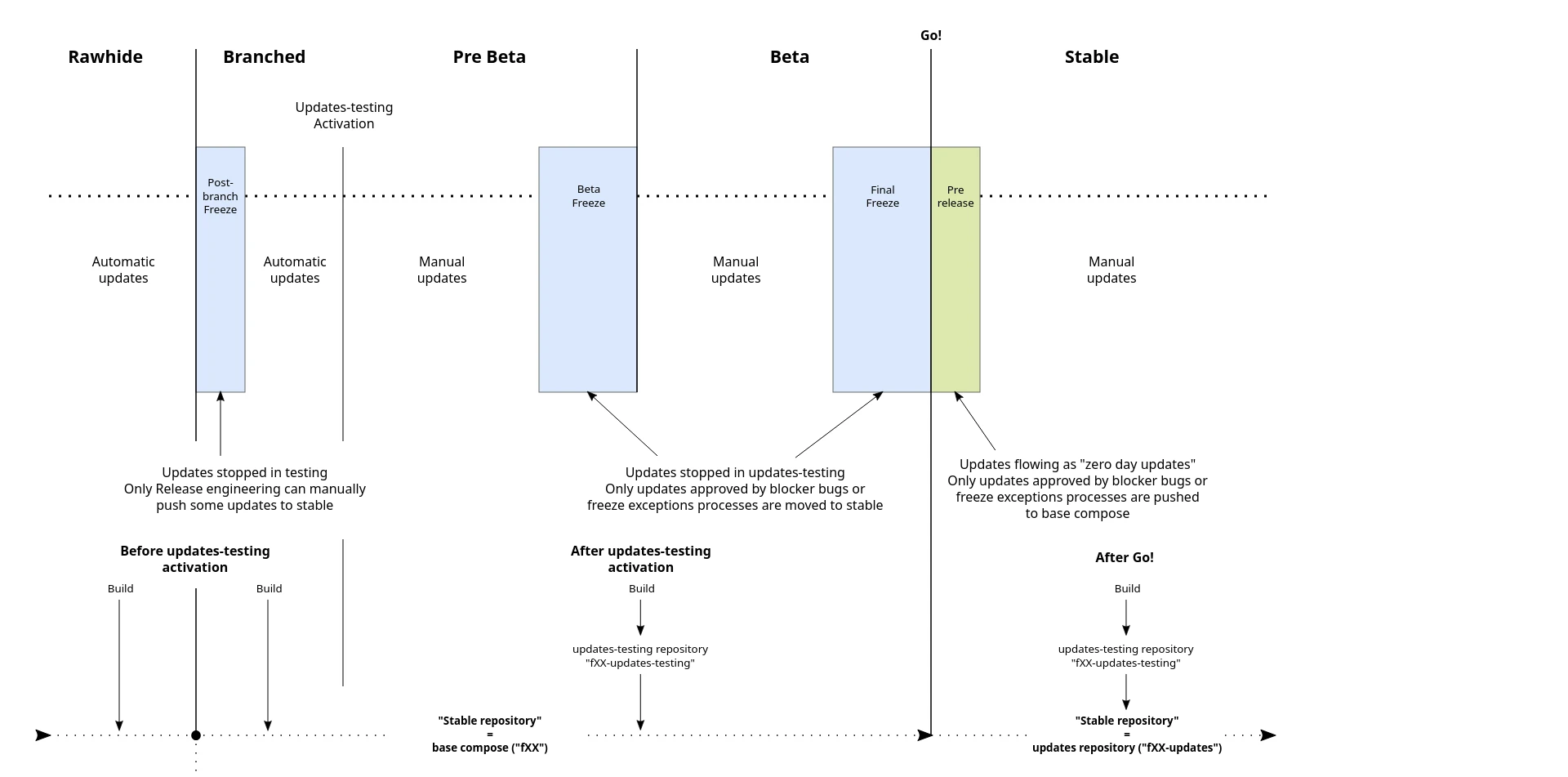
Every Fedora version declared Stable is released about once every six months and then receives 13 months of update support. During each Fedora major version’s support period, meaning within one year, package versions keep changing. This may not affect GNOME much, because GNOME releases one version each year and roughly aligns with Fedora’s update cycle, so it does not change much within a Fedora version. As for KDE Plasma, it is unpredictable, because its release timing is not fixed, so changing three or more times is possible!
Also, Fedora’s downstream, meaning the final stable version, is not a direct product controlled by the Fedora project, but RHEL, which cannot be freely used. Between upstream and downstream there is also CentOS Stream acting as a buffer, letting RedHat spend more time improving software quality. If you want a stable and free system, you have to use projects such as Rocky Linux or AlmaLinux.
Therefore, we can say that Fedora has never had a final stable system. It has always been changing.
Compared with Debian Stable, Fedora’s update cycle is far too short.
Treat Rolling-Release Distributions Cautiously, Even if They Have Seat Belts #
Now I treat rolling-release distributions very cautiously, especially those lacking maintenance by commercial companies. To put it nicely, I can regard rolling-release distributions as playgrounds for new features, encouraging people to explore them. But once there is no stability guarantee, they become toys.
Fedora users are influenced by its development model and constantly praise new technologies. The pace of iteration is hard to keep up with; every year something new may replace something old. For example, Wayland replacing X11, PipeWire replacing PulseAudio (btw PulseAudio is also awful), Podman replacing Docker, and so on.
The topic often heard recently is the immutable, or atomic, system update model. They say this can make systems more stable and updates more reliable.
The concept of immutable distro has existed for a long time, but only after 2019 did dedicated Linux distributions slowly begin to appear. The most famous implementation is led by Fedora Silverblue. This is an attempt to carve out another path outside regular Fedora.
I do not oppose exploring the new realm of immutable systems, but immutable cannot solve Fedora’s instability problem. Fedora is a semi-rolling-update distribution, and this remains true up to Fedora 44. It has version numbers and does not blindly chase the latest packages like Arch Linux. But in reality, software is released without long-term testing. At least compared with Debian Stable’s development model, which easily takes one or two years, Fedora’s six-month update frequency is far too high. This intensifies instability, and on top of that I use the KDE Plasma desktop, whose update frequency is much higher and less fixed than GNOME’s.
When people say Fedora is very stable and has never crashed, I wonder whether they have ever gotten a life, or whether “it works on my machine” counts as stable.
Debian developers call users who constantly chase new features over stability Shiny New Stuff Syndrome.
This is an illness. I am not asking you to cure it, but do not spread it everywhere and force others to keep up.
Many Linux distributions have been influenced by Fedora’s immutable distro trend and are discussing whether to launch their own immutable derivatives. But if you actually walk through the Debian community, in the current Debian 13 environment, you will find that they are not enthusiastic about Fedora’s fashionable immutable trend at all. I think many people probably think the same as me: with Debian’s model of at least two years of long development, rather than a six-month near-rolling-update model, software will naturally stabilize. Add Flatpak to supplement upstream software, and it is enough to provide an experience comparable to immutable systems.
At present I am still in a state of being unable to accept immutable distros, and I need to wait for a future brain upgrade. Or, if an immutable distro that does not adopt a rolling-update model appears, I will consider switching. For example, Vanilla OS and Bluefin LTS fit my expectations quite well, once they release KDE versions.
Then Just Be a Boomer #
Unable to understand new technologies and holding a resistant attitude toward them. Oh no, it seems it is my turn to become the boomer people talk about.
Originally, I had no particular opinion on technical disputes such as Systemd vs traditional init, X11 vs Wayland, and PulseAudio vs PipeWire. On the contrary, I encouraged many people to catch up and use the latest technologies, because those were not problems encountered by my generation.
I even thought people should use Docker more often to deploy SQL services on Linux servers, and that those still manually typing commands to install binaries are dumbasses. If a software developer does not know how to use Systemd to manage services and instead implements their own daemon, then I would say it is out of touch, a stubborn old thing.
But regarding the emerging concepts of atomic and immutable distros, I really have been annoyed by the propaganda lines of some people on Reddit. They say all day that the new Fedora Atomic distributions adopting this technology (including Silverblue, Kinoite, Bazzite, and Bluefin) are the best and improve many blahblah problems. Some even believe the traditional and reliable Debian development model should have been swept into the dustbin of history long ago. That attitude is hard to compliment.
I tried several immutable distros and read their documentation, such as Bluefin Documentation, which explains their philosophy, yet I still do not feel they have any advantage over traditional Linux. It is true that current Linux distribution development and maintenance have many problems, but they want to overturn the old model wholesale with a completely different method. It appears to solve old problems, but creates new ones. It destroys existing mature solutions and requires adaptation to new ways of doing things. It also sacrifices Linux’s inherent freedom.
Users should not be afraid of their systems. Even if developers want Linux users to adapt to a new image-based system deployment method for maintainability, we do not have to comply. The concepts introduced by the Fedora Atomic desktop are good for lazy users, since they do not have to fear breaking the system. But since I consider myself someone who loves tinkering, I think Debian’s traditional model is better. If there is software that needs to be removed, I can handle it with APT, rather than having it decided by the image that comes with the system itself. If you are always in fear that every update will break the system and therefore pursue rollback capability, then you used the wrong system from the start. You should not be using a rolling-release distribution.
If this kind of image-based system is the future, then ChromeOS really is the system everyone has been waiting for: a dumbed-down architecture whose GUI quality even wipes the floor with the proud mishmash served up by your open source community www
The immutable distro trend benefits developers and enterprise environments more; the improvement for ordinary users is negligible.
This is what an evangelist is like, just like the people who think “Rewrite everything in Rust.” The problems clearly are not solved, yet they specialize in creating new problems while feeling good about themselves.
I am not that rash. I will wait a few years to see how things develop before considering migration. Haste makes waste.
Trying to understand these evangelists’ thinking, I imagine that when Systemd first appeared, it was also because a group of maniacs led by Lennart Poettering promoted it everywhere, regardless of whether the methods were good, that it became widespread, leaving only a handful of BSD lovers struggling to survive.
I do not want to say that people crazily pushing these new Linux technologies are all RedHat’s lackeys. That would be too conspiratorial. Among emerging technologies, the one I can accept more is probably Flatpak, because installing software really is convenient. The system wants me to become immutable? Do not even think about it!
Have we not been poisoned enough by the dumbing-down of Chromebook and Android phones!? Although Windows and macOS are not dumbed down enough, the degree to which they oppress user freedom is already visible to the naked eye.
If not for my insistence on freedom, would it not be fine to obediently use Windows and macOS? But it is precisely because I want to preserve my own share of control that I want to use a Linux distribution that meets my expectations.
If I had to say something relatively neutral, it would be: Use what works for you. Do not develop FOMO and FUD just because you have not kept up with the so-called trend.
Borrowing terminology from American political junkies, when those left-leaning progressives are busy educating you on how advanced their future ideals are while ignoring present real-world needs, I understand the reason those American far-right conservatives post that rattlesnake flag: Don’t Tread on Me! Never forget that the world is full of suffering people!

The gossip is that the FOSS world’s alternative right-wing mad dog Bryan Lunduke has also posted this flag, except he changed the rattlesnake into his own dog.
We may be standing at a critical crossroads in history, but I choose not to rush ahead. If the future direction of Linux increasingly deviates from our expectations, then I will have no choice but to use BSD.