Money, violence, sex! Age verification
This page contains adult, violent, and gory content. Are you an adult? If you are not an adult, please click No to leave this page.
The book Savaged by Systemd: an Erotic Unix Encounter will tell you just how evil Systemd is… or perhaps, let you be seduced by Systemd’s charm?
I was defiled by Systemd… Systemd, this new-generation Linux init system, tramples the dignity of traditional MIS underfoot.
This book really exists!
Amazon purchase link: Savaged by Systemd: an Erotic Unix Encounter by Michael Warren Lucas
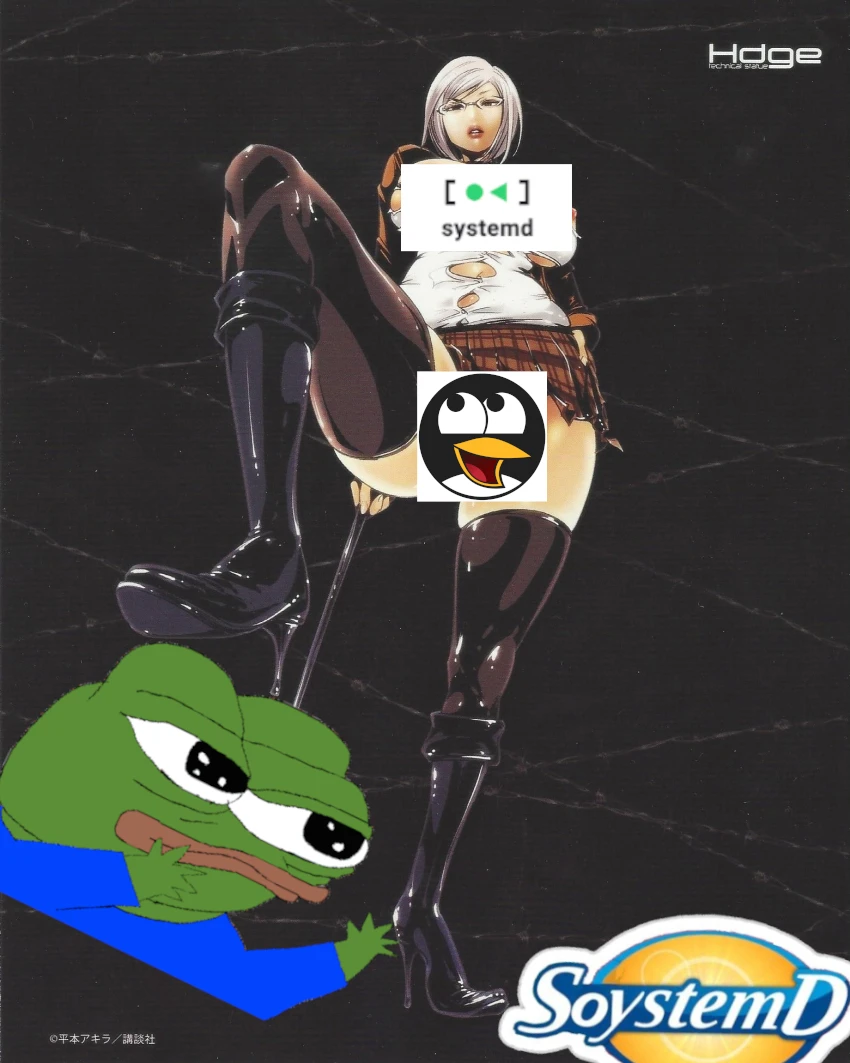
Just from reading the synopsis, the character that came to mind was the S-type character from Prison School, Meiko Shiraki.
The novel has no illustrations, so I southern-style Photoshopped this fantasy image from my head myself.
Adult version
1. Brief Introduction to the Novel #
You are in the server room. This is not an ordinary Friday night. Seriously, this is not normal at all. Terry is the stereotypical old-school Unix system administrator. He cares for every server with a delicacy verging on mysophobia, while keeping a safe distance from all “latest-trend garbage technology.” Running a KDE or GNOME desktop on a server? Please, stop screwing around. Want a GUI? Then obediently go back to the FVWM window manager: clean, sharp, no bullshit. And one of the “latest trends” Terry rejects, the one almost the entire world has quietly accepted, is precisely the thing that claims it will replace traditional init: Systemd. Then… Systemd shows up at the door. Wearing absurdly tight leather pants. Yes, this is really not a normal night in the server room.
2. Plot Summary #
The PDF version can be found online.
The protagonist, a greasy middle-aged system administrator who follows the Unix philosophy, meets a woman named Systemd while handling things at the office. She knocks on the door in the pattern of the Fibonacci sequence, and only then does the protagonist let her in. Then she immediately kisses him.
She shows him where her allure lies, making the protagonist submit to her, letting Systemd enter your body and possess you.
She is a seductress who says, “I can give you everything.” This reveals the part of Systemd that wants to do damn near everything. So you must listen to me!
“I am always in control of everything. If a service dies, I restart it!” Systemd says this while touching the protagonist’s asshole.
On a rational level, he knows init should not do too many things, and that Systemd is overly complex and invasive. But on an emotional level, he is seduced by Systemd’s convenience, integration, and power. In the end, even though he knows the philosophy is wrong, he still surrenders.
“As long as you accept me, I will make everything better,” Systemd says.
The protagonist goes from resistance, to dependence, to addiction. In the end, he even serves Systemd.
3. The Systemd Controversy #
All right, you have finished the book and jerked off. Now let’s talk about something serious.
This novel was published in 2017.
In 2014, Systemd appeared as a modernized init system. Under Redhat’s leadership, it began being promoted at large scale across major Linux distributions, replacing the traditional Sysvinit system, and at the time it sparked a huge controversy among Linux users.
For detailed discussion of the controversy, see: No systemd - Resources against systemd and alternatives
The main criticism is that Systemd has too broad a reach, violating the Unix philosophy of “Do one thing and do it well.” Systemd went from being a program that simply manages system services to also taking over program logs, USB hotplugging, disk mounting, crontab, and network connections. This is vastly different from the traditional Unix way of doing things, and it also increases the complexity of system maintenance. Some traditional Linux users believe that a program for managing services should simply do its job well, without wanting to do everything.
Many people were pissed off by Systemd and launched alternatives one after another, such as OpenRC and Upstart, trying to remain compatible with the existing Sysvinit while avoiding excessive complexity.
However, after ten years passed, Systemd has already become the mainstream init system in the Linux world, because it really did simplify many difficulties in system maintenance and made system administration more standardized. Only a few niche Linux distributions are still stubbornly holding out.