It seems that young teachers nowadays do not often use Microsoft Office. Most directly use Google Docs to share files, presentations, spreadsheets, forms, class assignments, and so on. But from what I see, older professors are still used to opening Word and PowerPoint in class. Maybe the sample size is too small.
The places I mainly interact with are public and private educational institutions, where there is a lot of document exchange.
In the past, probably more than five years ago, when Windows was still my main system, I used Microsoft Office more. Price was not a problem, because I could always get the whole suite through discounts or educational institutions. Many people also took Microsoft Office formats for granted when exchanging files.
But after switching to Linux as my main system, the occasions where I used Microsoft Office dropped sharply. I began using Google Docs heavily.
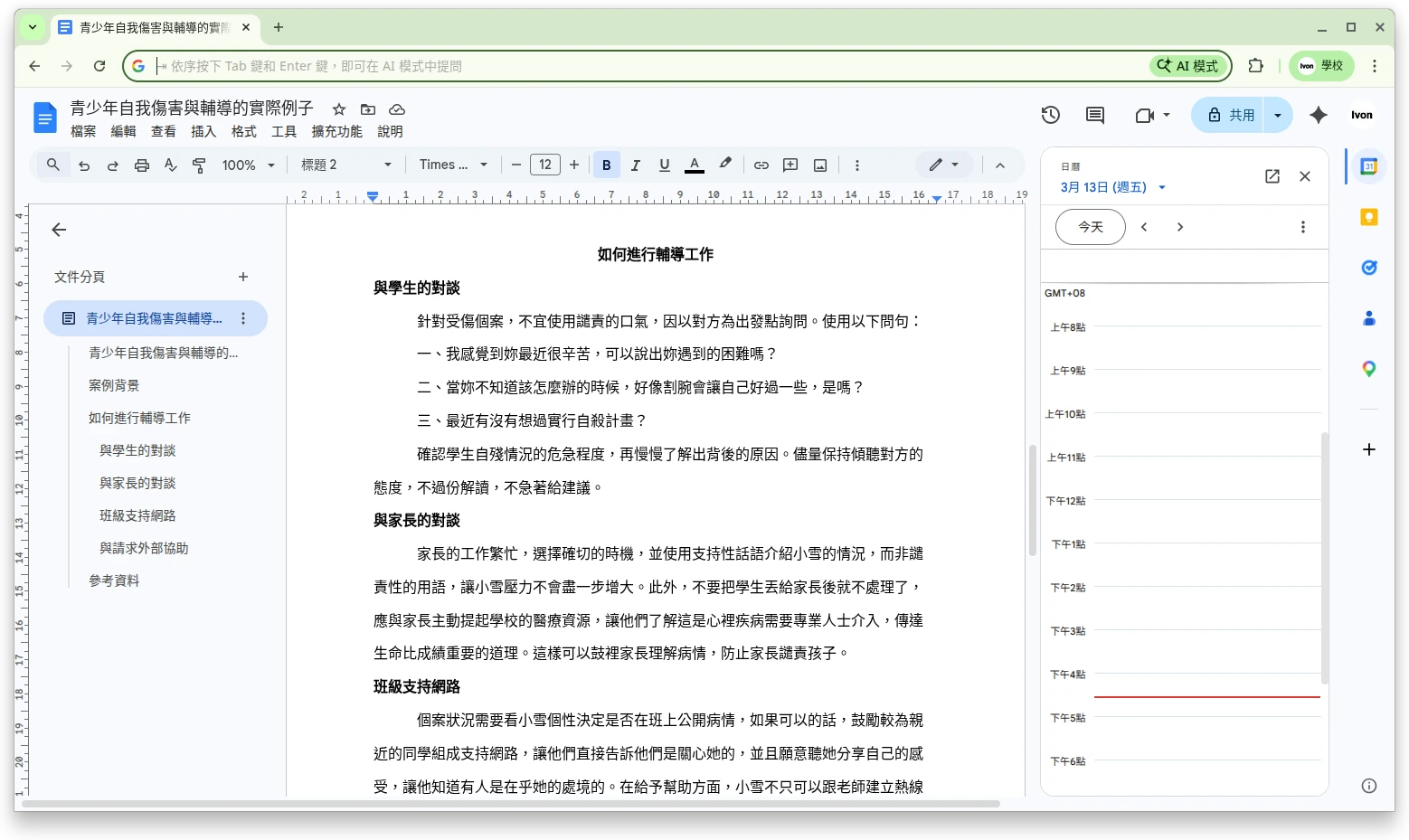
Now, sometimes I have to thank the evil Google Docs for letting me almost never need the even more evil Microsoft Office in educational settings, and for giving me a usable option when LibreOffice is hard to use. Because Google Docs only needs a browser, and Chromebook is basically a computer born for this. Also, the Chrome browser, which has the best compatibility with Google products, also has a Linux version, so when working on my main Linux computer, I do not need to open a Windows virtual machine for weird Office documents. I know certain versions of Microsoft Office can run with Wine, but there are many problems. Even though Microsoft Office has launched a web version, its features are so crippled that one might as well use Google Docs.
What about LibreOffice and OnlyOffice? These free software projects have good intentions, but they are useful only when running locally, which looks somewhat outdated in this modern cloud era, and I am lazy. Web-based cross-platform solutions are immature. Not many people have the ability to self-host web-based Nextcloud Office, so Google Docs is the best compromise. Now I probably use Google Docs for 90% of cases, and only very occasionally open LibreOffice when I need to handle complex layout.
Now, for cross-platform office work, no matter what operating system you use, you can work through Google Docs: computers have browsers, and phones have APPs. The benefit is that you are not tied to a single system and software. But the potential downside is that you are tied to a cloud service that is even harder to leave, and Google Docs is not free software. Also, although Google Docs appears compatible with .odt and .docx file formats, it actually mainly uses its own file format, not native .odt, and due to business considerations chooses to lean toward better .docx support. Therefore, after downloading and converting, there is no guarantee the layout will not shift, and interoperability with LibreOffice is not 100%. To fully preserve Google Docs layout and open it in other software, saving as .docx is safer.
I think this has been Google’s layout over the past decade: through a cloud-native-first strategy, paired with Chromebook, it has captured the next generation of office platforms.
This reminds me of the ecosystem Apple tries to build. Some Apple fans say Apple uses somewhat low-priced but not cheap products (such as iPad student plans) to capture the education market. After tying people into the Apple ecosystem, when these people later enter society and have money, they will be more willing to buy more Apple products, including phones, tablets, laptops, watches, headphones, and so on. They also automatically gain a label cooler than Windows. I have indeed witnessed piles of consoomers proudly owning full sets of Apple products. If a former Windows user switches to Mac, it can even be called an “awakening”, because you have broken free from most people’s habitual choice. This may be conspiracy theory, or it may be precise business strategy analysis.
So, is there anyone who, after using Apple, “awakens” again and jumps to Linux!? That requires a very strong spirit of martyrdom. More broadly, we should not be tied to a walled-garden and still feel smug, nor defend big companies after being sold out. Every solution from top to bottom, from hardware to software, should be based on open standards. For example, to sync files, use Syncthing or Nextcloud, reject iCloud and OneDrive, and even more so reject the Google Chromebook ecosystem!
That is what I say, but for education-related work, I still need office software to share files with others. In that case, Google Docs, which works in the browser and does not restrict the operating system, is a solution I can more easily compromise on and accept, because it also runs smoothly on Linux. As for whether Google Docs has FOSS alternatives: yes, but they are too troublesome. So under compromise, Google Docs is still the best.