When We Discuss Which GNU/Linux Desktop Is Better, Do Not Drag Windows Into It.
Note: This is an article written from the perspective of a Linux fanatic. It is somewhat biased, with ideology outweighing practicality.
The problem criticized throughout this article can be described with this image.
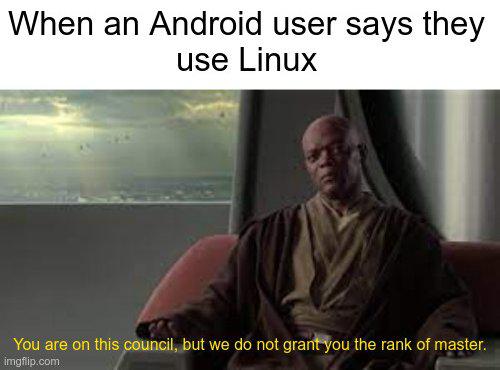
When members of the Linux community discuss the strengths and weaknesses of KDE and GNOME, there are often implications under the surface. The two most common arguments are the following, and hearing them makes my balls catch fire.
- Linux’s two major desktop environments, GNOME and KDE, are too bloated, so choose XFCE/LXQT/Cinnamon/Deepin blah blah blah. Or even skip desktop environments entirely and switch to tiling window managers such as i3/sway/dwm, which are the most stable and efficient, then build a pile of complicated custom designs.
- None of Linux’s desktop environments are easy to use, so I choose to install “worry-free” Windows with WSL, only access command-line development tools, and pretend I am also a Linux user. “Windows is the best Linux distribution.” Or buy macOS and proudly become an Apple fan because the whole ecosystem is easy to use, or even buy a Chromebook because audio and video entertainment are easier to get started with. This way I count as using a Linux environment too. (Highly likely to appear in answers on Zhihu, Mobile01, and PTT.)
I will address these two opinions separately below.
1. You Should Still Use Mainstream Desktop Environments #
Regarding the first problem, it is not that I want to belittle developers’ efforts, but I still think mainstream opinion should be referenced.
Some radical tiling-window enthusiasts think mainstream Linux desktop environments are complete garbage. Their criticism is not the Windows critic’s claim that the desktop is not friendly enough, but that KDE and GNOME are too complex, the developers do not know what they are doing, they add a pile of features randomly, and they are not as efficient as our tiling windows. They insist on the KISS principle, saving desktop environment resources wherever possible. Usually these users use distributions such as Arch Linux and Gentoo, and those with an init freedom attitude may choose Artix, Void, or Devuan without systemd. The characteristic of these distributions is that they do not have much preconfiguration. After packages are installed, users must configure them into the shape they want, with no stupid commercial company policies forced down their throats. So customizability is extremely high, using minimalist resources to reach 100% of the form they have in mind. Some even compile software themselves to meet their requirements, such as Gentoo’s USE Flags and Nix package settings.
As an aside, even now there are people in the Linux community who hate Systemd, thinking it is an evil thing RedHat forced everyone to swallow down the throat, causing some people to deliberately choose distributions without Systemd, such as Devuan, Artix, and Gentoo, continuing the philosophy of traditional Unix init. Similar examples include Wayland, PulseAudio, and Snap. Once these cross-platform standards are pushed hard, they are questioned. After all, people often hold a negative attitude toward new things, unless they find their own “it is actually good” moment. Time has proven that Systemd is the most successful and widely accepted thing in these decades. Almost all distributions have switched to Systemd, and it modernized the init system. So, will the next one be Wayland? In any case, X11 has already stopped development, and most desktop environment development teams have shifted their work toward Wayland. Also, PulseAudio will be replaced by the more advanced PipeWire. Then who will be the winner of the “unified package format”? Can Ubuntu defeat the vast power of the community and make Snap flourish, or will Flatpak, now gradually preinstalled by more and more distributions, win?
Returning to desktop environments, although this is very much a matter of personal preference, if you do not recommend the desktop environments used by the most people, and instead tell beginners and intermediate users to use desktop environments that emphasize simplicity, lightness, and high customizability, then in the end inexperienced people cannot solve problems with overly crude GUIs. I think anything that cannot cooperate with other desktop environment software is not okay. If they have to use commands to change system settings and then complain that Linux is unintuitive, I think that is hurting people. I also would not recommend that people install Arch Linux right away. Tiling window managers have their efficiency, but they are simply not intuitive, so I cannot recommend them first. Some people cannot even adapt when switching from Android to iOS. If they choose an overly minimalist graphical interface as soon as they start using Linux, I really think that is not okay. KDE and GNOME are both doing their best to improve the out-of-the-box experience and define standards. GNOME even has commercial companies pampering it. To put it harshly, other desktops can only be second-class citizens.
Although I agree that Linux should be user-centric, not user-friendly, from a practical perspective, I think excessively customizing one’s own system leads to extremism and madness. Desktop environments need compromise and cooperation, and public standards should be established to support more usage scenarios. If everything is based on a command-first, handmade mindset, I am afraid it cannot keep up with the trend of the times. No matter how much it emphasizes system freedom, simplicity, efficiency, how comfortable customizing the system is, that Nix is the best package manager, and so on, most people simply do not have the time to mess around like that. Having a graphical interface to control system services is not redundant; it is progress. We want a modern GNU/Linux system, no longer something exclusive to hackers.
For me personally, after trying different desktop environments, it eventually became a duel between GNOME and KDE. By now, many of my devices uniformly use KDE, with only theme colors differing. To me, GNOME is really hard to use 💔 KDE can be compared to Windows: feature-rich, with a higher degree of interface customization. GNOME is closer to MacOS: application styles are unified and the interface is more minimalist. But I believe that no matter how GNOME supporters emphasize its “simplicity and ease of use,” it ultimately cannot match the “convenient and powerful” KDE ecosystem. That is all. I hope more distributions can adopt KDE as the default option.
As for graphical operations, I also suffer. Everyone uses a different Linux desktop, so it is hard to write instructional text like “Next, open KDE Discover…” in tutorial articles. What if the reader is a Linux Mint user? Not every reader can infer across contexts and know how the next step maps to their own operation. Sigh, so when installing Flatpak, I mostly still give commands directly. If readers are already familiar with their own desktop environment, they will naturally know how to open the app store and search for Flatpak programs without typing commands. The principle I now hold is: “Use GUI settings when you can; commands step back a little.”
2. We Are Talking About GNU/Linux Now #
Regarding the second problem, I think people who say this need to retake Chinese. The issues we are discussing are not even on the same dimension. I am talking about desktop applications; you are talking about system development.
Kenshiro can knock down an opponent with one finger; I can refute this with one sentence: you have put the cart before the horse.
For GNU/Linux, SteamOS, ChromeOS, and Android are relatives; macOS and Windows are friends. WSL is the illegitimate child.
But we cannot blame people who speak this way too much. Many people are used to being consoomers and do not know what it feels like to be an owner. Some people also see Linux as a cheap, free-of-charge substitute for Windows. If it cannot sufficiently substitute for Windows, they do not want to use it. But we should actually see it this way: all systems develop in parallel, each with its own customer needs. You cannot expect software designed for a single platform to be able to run on other platforms. To be honest, companies that still develop software for only one platform today are also backward in their thinking, except games of course.
Free software developers do not think about conquering the world and using every method to fight for market share, but they do their best to promote the idea of freedom. I have to admit that Linux really is not very intuitive. I only hate these kinds of answers so much because I look at them from the perspective of a Linux fanatic. Taking freedom as the first faith-value is the premise of using Linux. Using “WSL” and the prettier macOS to belittle all Linux distributions is equivalent to denying that value.
As Xi Jinping once said: Without the 1, no matter how many 0s there are, they have no meaning.
From a practical perspective, it is good that WSL can help complete programming development work. This means Microsoft has finally discovered its conscience in recent years. I am very glad that when I am forced to use Windows in the school computer lab, this good thing can still temporarily rescue me from suffering.
But from a moral perspective, a complete GNU/Linux system still surpasses Windows, because Windows itself is a system that does not respect user freedom and privacy. Being tied to it is terrible. Running Linux containers on Windows may awaken you to install real Linux, but it may also tie you to this product forever, making you john for life, treating Linux as a program rather than a complete system.
Installing WSL on Windows is a compromise choice when “your computer is tightly controlled by an evil company/organization/school and cannot install other systems.” It is not what Linux originally looks like. Linux is not only meant to stay in pure-text server environments! If you have not experienced Linux entering your heart, soul, and brain, do not lightly deny the efforts of Linux desktop environment developers around the world.
If someone talks nonsense about Windows being the best Linux distribution, they are 100% here to cause trouble. We are discussing the design strengths and weaknesses of GNU/Linux desktops, not ways to run Linux. This is like saying, I install Termux on Android and iSH Shell on iOS, so I am also a professional Linux user! Pah! What kind of Linux user is someone who turns around and downloads a truckload of proprietary software from the app store?
By the time Windows developed into Windows 11, it had already become a large surveillance machine. Besides not being free software itself, there are countless ads, app store promotions, AI embedded into the system, a search engine that keeps encouraging you to earn money and buy points… GNU/Linux does not deeply interfere with these things related to the system’s low level, and by default it is very clean. Rather than saying Linux should stay in a virtual machine while bare metal uses Windows, it is Windows that should stay in a virtual machine, while daily use should switch to Linux. It is not like we lack efficient KVM technology that can access virtual machine things with low latency. At least for the system used 90% of daily time, privacy and freedom cannot be compromised.
Although macOS has a terminal similar to Linux, an interface and operations with unique aesthetics, and is ready to use out of the box like Windows, it is still a non-free system. Like ChromeOS, it is tied to hardware and hard to crack. I have seen too many articles blindly praising macOS design aesthetics, even citing paper theories to prove why Apple designed it this way. But they do not realize that no matter how beautiful this system is, it will always be a proprietary operating system. The Apple ecosystem seems convenient, but in reality it is a kind of kidnapping. Even more frightening is that there are almost no alternatives: without me, you die.
macOS aesthetics are only a little better than Windows and cannot stand shoulder to shoulder with Linux. Morally speaking, FreeBSD may even be better than macOS. If not for proprietary software support, and the fact that iOS APPs have to be developed with macOS, would there still be so many suckers buying Macs? Mac industrial design and screens do look good, that is true, but I think it is flashy and impractical.
ChromeOS may take away some of the share of users who think Linux is “specifically for reviving old computers” (there really are a bunch of YouTube users who use Windows 99% of the time introducing Linux this way; I think their promotional focus is wrong), but under the condition that it loses across the board in professional use, its threat is not as large as Windows and macOS. What it will hit should be the user market addicted to tablets and phones, and many of those users are already brainless to begin with.
3. Conclusion #
In Is Android the Best Linux Distribution? Grievances About Linux Desktop Distributions, I talked through a series of admiration for how Android and Windows succeeded, as well as my disappointment with Linux. But in the end, I still choose to continue using Linux. The world today is kidnapped too severely by proprietary software. Users and creators are accustomed to the superficiality of commercial products and do not cherish the value of freedom.
Some people mistakenly think free software is the same thing as software free of charge. In fact, they are still different. Free-of-charge software hides many dangers, including elements that lure users, with freemium as the most common form. Free software may be harder to get started with, but the value of freedom it cherishes cannot be ignored. Its purpose is not to please, lure, and kidnap users with a beautiful interface.
Although Linux users have the freedom of choice, in order to promote a just and healthy concept, we should still be a bit more wary of non-mainstream opinions. Linux itself is not a mainstream desktop system. If we still let external forces nibble away at our values, that would be an even sadder thing.