XLibre is an X Server project that intends to replace X.Org.
Generally speaking, in recent years we have often heard that Wayland is about to replace X.Org X Server and become the new generation standard for Linux graphical environments. But what if someone wants to extend the life of X Server, rather than tear everything down and rebuild it?
How should we install this brand-new X.Org fork and extend the life of X Server? What controversy has this caused behind the scenes?
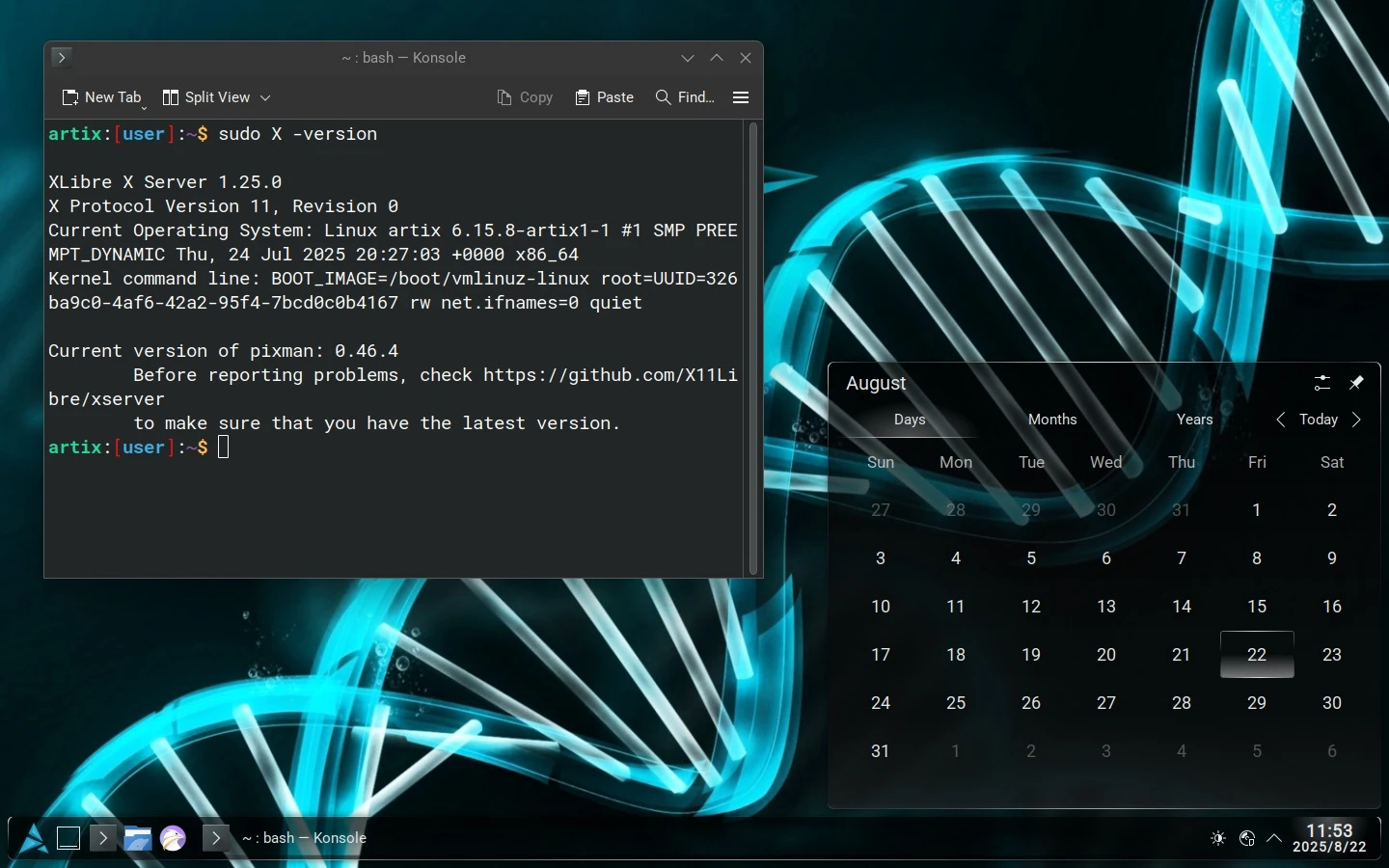
Artix Linux running XLibre + KDE X11
1. Why Does XLibre Intend to Replace X.Org? #
First, some historical context.
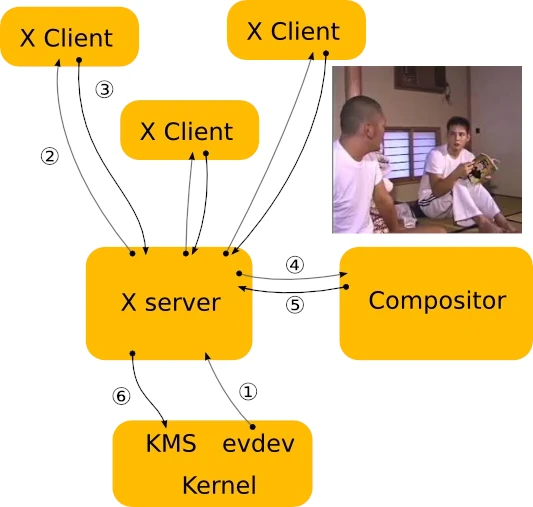
X Window, also called X Server, is a set of software for displaying graphical interfaces. It defines how to interact with underlying hardware, and is responsible for low-level graphics drawing and mouse event management. It can be said to be indispensable software for displaying a GUI. But users do not directly operate X Server; they interact with the desktop environment. How did desktop environments come about? Because X Server handled the low-level communication with hardware, software developers could develop complete desktop environments on top of the X Server architecture, such as GNOME and KDE Plasma, and then users could operate the operating system.
Since its birth at Bell Labs in 1987, X Server has been used to this day, becoming a standard dependency for desktop environments on many Unix-like systems (Linux, BSD, Solaris).
The original X Server developers only defined the X communication specifications and did not specify concrete software implementations, so an implementation of X Server was needed for users to install. X Server has many versions implemented by developers, such as XFree86 X Server released in 1992. It was once mainstream, but because commercialization triggered community controversy, a group of developers forked it in 2004 into X.Org X Server, which became the most popular X Server implementation.

Now in 2026, the open source community still most commonly uses X.Org X Server. Because the X protocol it uses is version 11, it is also called “X11.” Most people use the names “X.Org” or “X11” to refer to this X Server.
However, because the architecture of X.Org X Server is too old and its mountain of shit code is hard to maintain, it has produced many security concerns. For example, communication between X Client and X Server is not encrypted, so it can easily be intercepted by keyloggers.
In 2008, some X.Org X Server developers started the “Wayland” project, intending to replace X.Org with a more modern graphical system.
Related article: Should you switch to Wayland desktop?
After that, mainstream Linux distributions began migrating toward Wayland and gradually abandoning X.Org support. For example, the GNOME desktop began providing Wayland sessions. But due to various factors, Wayland could not immediately replace X.Org, and the two existed in parallel for a long time.
The reason replacement is difficult is that Wayland and X.Org architectures are incompatible, equivalent to tearing everything down and rebuilding it, and programs have to be rewritten. Many operations that can be easily done on X.Org simply have no related API available on Wayland, and the core developers of Wayland protocols have to slowly improve them. For example, for a long time Wayland desktops had no unified screen recording method. Each project had its own implementation, affecting development of recording software OBS Studio, until the emergence of PipeWire technology greatly improved this problem. These factors caused developers to have low willingness to migrate.
Considering that X Server has so many implementations, such as XFree86 and X.Org, why does Wayland not have this problem? Wayland actually has some forks too, such as Canonical’s Mir (which ultimately failed) and ChromeOS’s Exosphere. But because Wayland’s initial architecture is simpler than X Server, defining only the communication protocol at the start and leaving the rest to each compositor to implement, it inherently caused fragmentation, so forking Wayland is not very meaningful. It is also possible that, like Systemd, the main developers firmly control the development progress and prevent it from being hacked around.
In 2024, the process of Wayland replacing X.Org began to accelerate. The main reason was that RedHat, the big brother of the Linux world, completely removed X.Org support in the latest RHEL 10 and forced Wayland usage. Even the default GNOME desktop environment had already abandoned X.Org, retaining only XWayland for compatibility with old X11 programs. XWayland is a nested X Server that depends on Wayland to run. It can only run within an existing Wayland desktop and cannot be used independently like X.org X Server.
Since the leader has done this, it is bound to affect the decisions of other Linux distributions, forcing developers to turn toward supporting Wayland.
Many developers are improving functionality for Wayland, including mainstream GNOME and KDE Plasma desktops, both of which will prioritize Wayland support. By comparison, X.Org has already entered hospice. There are almost no new features, and it has become “if it works, do not fix it.” Developers want it to disappear naturally.
By 2025, RedHat did not even intend to continue maintaining the X.Org X Server code. They were gradually removing X.Org X Server from their partner FreeDesktop source code repository.
At this point, a group of developers could not stand this behavior, jumped out, and forked X.org X Server, calling it XLibre X Server.

This is the largest action by the open source community since XFree86 X Server forked into X.Org X Server in 2004.
They chose to continue the life of X Server, rather than let Wayland move toward an unknown future.
XLibre X Server intends to continue the abandoned X.Org X Server, keep improving its architecture, and forcibly extend its life. It applies to XLibre all the patches rejected by upstream X.Org, such as the brand-new “Xnamespace Extension”, which can increase X Server security. It also enables the TearFree option by default to prevent screen tearing on some graphics cards. For specific improvements, you can check the Github commit history of XLibre developers.
XLibre developers are calling everywhere for Linux distribution and BSD system developers to join their revolutionary cause, “liberate” their desktops, and include XLibre in system repositories.
By 2026, XLibre has gradually been included by some Linux distributions, replacing old X.Org packages.
2. Controversies Around the XLibre Project #
Some people believe XLibre is not a panacea for saving X Server, nor is it necessarily a good choice outside of replacing Wayland. This is specifically reflected in the following problems:
First, ideological problems
- Friction between XLibre developers and X.Org developers. XLibre’s main developer Enrico Weigelt once sent a large pile of patches to X.Org’s Gitlab repository, attempting to improve X.Org security issues. But not long after, they were withdrawn. X.Org developers believed his code quality was poor, that it had been submitted without complete testing and was disruptive, so they kicked him out of FreeDesktop repository access. Therefore, he had no choice but to come out and make XLibre himself. This forked project may permanently become a hard fork and may not necessarily merge changes back upstream into the X.Org project.
- Political stance problems. XLibre’s main developer Enrico Weigelt has been accused of supporting the far right and opposing DEI. XLibre’s Github Readme sarcastically wrote: “We don’t care about your political stance or sexual orientation” and then stopped there, completely ignoring the standard practice of a Code of Conduct, which led many developers who follow formal Codes of Conduct to boycott it. XLibre supporters, in turn, accuse FreeDesktop of having been polluted by left-wing woke people.
- Lack of support from large commercial companies. Many Linux distributions regard Wayland as mainstream and consider X.Org outdated technology, so they are unwilling to include XLibre packages. For example, mainstream commercial distributions such as RHEL, Ubuntu, and SUSE have all migrated toward Wayland and are letting X.Org die, with no plan to support XLibre. Fedora and Debian developers have sternly refused to join XLibre. This may cause XLibre to become a plaything of underground hackers.

Second, technical problems
- Since XLibre is an implementation of X Server, it should be compatible with X.Org’s existing specifications. In theory, it should be able to serve as a drop in replacement. However, even though X.Org is about to be replaced by Wayland, major Linux distributions still have many packages depending on X.Org. Hastily adding XLibre to Linux distribution repositories will cause many programs’ dependencies to collapse. Also, XLibre is a very young project that appeared only in 2025, and nobody can be certain whether XLibre can stably replace X.Org in the future.
- Some graphics drivers are compiled against old X.Org, such as Nvidia proprietary drivers. Migrating to XLibre will cause drivers to not work out of the box and require manual configuration file adjustment.
- XLibre may not solve X.Org’s inherent problems. Some brand-new graphics technologies are easier to implement on Wayland and almost impossible to implement on X Server, such as HDR and VRR support. Although someone has indeed implemented HDR support in XLibre.
- More and more graphical program developers have completely abandoned X.Org support and moved toward Wayland. Asking them to turn back and support X Server goes against the direction of progress and increases developers’ maintenance costs.
3. How to Install XLibre X Server #
Overall, if you are willing to join this revolutionary cause and take the lead in helping improve XLibre, then install it on your system right away and try it.
Reference: Install Xlibre X Server